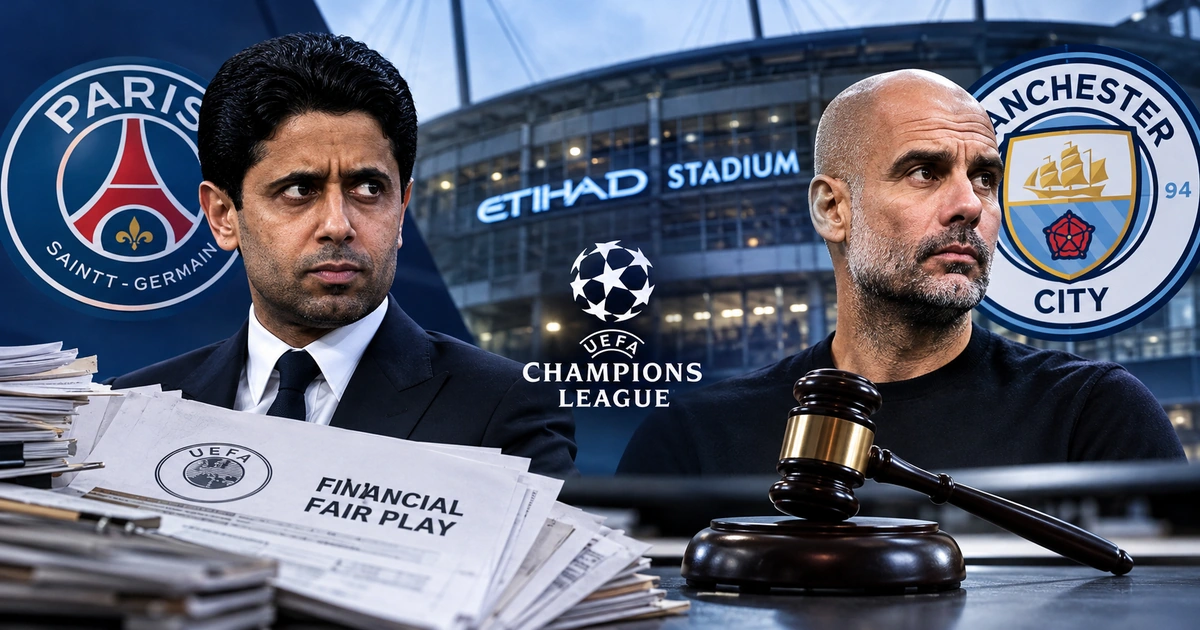
Nasser al-Khelaifi was unhappy with the timing of Manchester City’s guilty verdict, released by the Premier League just a fortnight ago. Yet when the Paris Saint-Germain president arrives at the Etihad Stadium for Wednesday’s Champions League meeting, the occasion carries an uncomfortable reminder: the story might have unfolded very differently for both clubs.
Manchester City and PSG’s Shared History of Financial Fair Play Breaches
Manchester City and PSG are connected by more than their Gulf-state ownership. They were among the first major clubs found to have broken Uefa’s financial fair play rules in 2014, and the scale of the figures involved was so large that later cases appeared modest by comparison.
The breaches concerned the period from 2011 to 2013, when clubs competing in European competitions were permitted to record a maximum loss of €45m (£38m). Uefa investigators calculated that PSG had suffered a deficit of €218m, while City’s stood at €188m. Despite those figures, neither club was formally charged at the time. Instead, both reached settlement agreements with Uefa.
Uefa’s 2014 Financial Settlements With Manchester City and PSG
Looking back, the terms appear remarkably generous. Each club received a €20m financial penalty and accepted tighter limits on spending during the years that followed. There was also a further €40m liability for each side if the settlement conditions were broken. The arrangements were designed to keep the clubs within the competition while placing restrictions around their future activity.
In April 2017, Uefa declared that City and PSG had “fully complied with all the requirements”. That statement did not end the arguments surrounding City’s conduct. In 2020, following an investigation by Uefa’s investigatory chamber, City were suspended from the Champions League for two years. The charge involved “overstating its sponsorship revenue” between 2012 and 2016.
The punishment did not survive the appeal process. The Court of Arbitration for Sport overturned the suspension, concluding that “most of the alleged breaches were either not established or time-barred”. The decision became a major part of City’s long-running defence, as the club continued to reject claims that it had deliberately broken the rules.
Premier League Commission Finds Manchester City in Breach of Financial Rules
Then came the Premier League’s announcement last month. An independent commission examining more than 100 charges against City concluded that, between the 2009-10 and 2017-18 seasons, the club had been “significantly in breach” of Uefa’s spending limits. The commission also found that City had “filed misstated accounts and concealed the true state of its finances”. City have appealed against the verdict, and their protestations of innocence remain firmly established.
PSG have also faced further scrutiny since the original settlement. Uefa fined the French club another €10m in 2022 for failing to comply with financial rules from 2018 onwards. A further €50m penalty was suspended, leaving the club with another warning that its conduct would continue to be examined closely.
Nasser al-Khelaifi Frustrated by Timing of Manchester City Verdict
Al-Khelaifi’s frustration with the Premier League announcement was not limited to the verdict itself. The timing meant that the publication of the independent commission’s core judgment on City overshadowed the general assembly of European Football Clubs in Copenhagen. Al-Khelaifi was due to deliver the keynote speech, while City chief executive Ferran Soriano sat in the front row before quickly moving away from television cameras.
The scene captured the awkward distance between the two clubs. Al-Khelaifi, speaking as chair of the EFC, presented plans to turn the organisation into a global body. He also directed pointed remarks at Fifa president Gianni Infantino, stressing the importance of good governance. His tone was notably different from his attitude towards Infantino a decade earlier.
Der Spiegel Investigation Raises Questions About Gianni Infantino’s Role
A 2018 investigation by the German publication Der Spiegel claimed that Infantino, who was then Uefa’s general secretary, had played an important role in helping City and PSG avoid more severe consequences in 2014. The claims included meetings with officials from both clubs described as “secret talks”, along with the provision of confidential materials containing suggested “compromises that he was unauthorised to propose”.
An email published in that investigation was sent by Infantino to City chairman Khaldoon al-Mubarak on 2 May 2014. It outlined the terms of a possible settlement. Infantino wrote: “You will see that I’ve sometimes chosen a wording which ‘looks’ more ‘strong.’ Please read the document with this spirit.”
The settlements with City and PSG were eventually agreed that month. Before that happened, Brian Quinn, head of Uefa’s investigatory chamber and a former senior Bank of England official, resigned amid reports that he regarded the agreements as too lenient. His departure added another layer of unease to a process that had already raised questions about how the rules were being applied.
Uefa and Infantino Defend Financial Fair Play Settlement Process
Uefa defended the settlement system at the time, saying: “In cases where clubs overspend and balance their books only thanks to money injections, a settlement agreement has always been the preferred solution. In such cases, the focus is on limiting the revenues coming from outside football.”
Infantino also defended his role. He said his “job entails having discussions, having conversations, exchanging documents, drafts, ideas” and that he had performed his duties “in an honest way, in a professional way and trying to defend the interests of football”.
PSG continue to insist that they have “always acted in full compliance with the laws and regulations enacted by sports institutions”. City have likewise maintained their position of innocence. But despite their shared history, the clubs now occupy very different places in European football’s power structure.
PSG and Manchester City Take Different Paths in European Football Politics
Al-Khelaifi will arrive in Manchester as a figure closely tied to the establishment. European Football Clubs is a joint shareholder with Uefa in the commercial company responsible for running the Champions League, placing PSG close to the institutions that shape the competition. City, meanwhile, remain on the outside of that comfortable circle, still challenging the system and fighting what they see as an entrenched football machine.
The contrast is likely to be felt inside the stadium. Many City supporters will continue to express their disdain for Uefa by booing the Champions League anthem. Yet behind that familiar show of defiance, some may quietly wonder whether Abu Dhabi’s leadership could have chosen the more diplomatic route taken by PSG. The two clubs began with remarkably similar problems, but their decisions afterwards have left one at the top table and the other still raging against it.