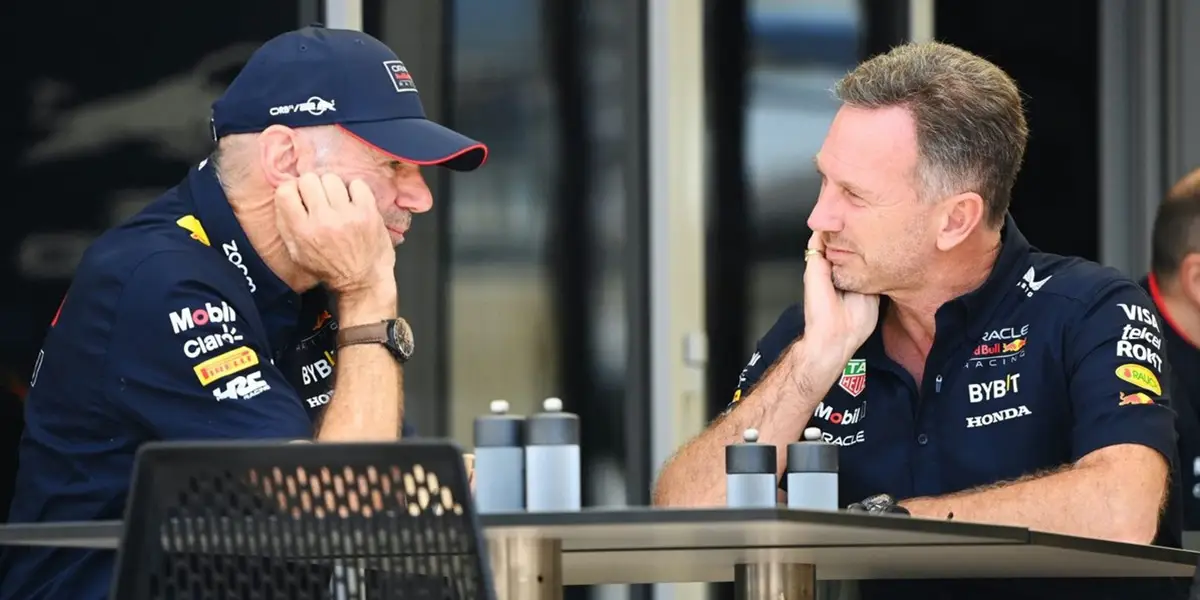
Christian Horner believes Adrian Newey’s difficult start at Aston Martin has striking similarities to the designer’s early years at Red Bull, although the two projects are not identical.
Speaking about Newey’s move to Silverstone, Horner said Aston Martin had not been ready or equipped for the way the celebrated designer works. “From the outside looking, it's just history repeating itself,” he said. “He's obviously gone to Aston and ought to work in the manner that he's used to. And they've obviously not been ready or equipped for that, so he's no doubt in the process of trying to structure that.”
Christian Horner recalls Adrian Newey’s difficult early years at Red Bull
Newey joined Red Bull from McLaren in 2006, but Horner recalled that the team’s existing technical group initially expected the new arrival to adapt to its methods. Horner took the opposite view.
“There was a pushback when I recruited Adrian and convinced him to come,” Horner said. “There was a feeling, certainly within the old guard of the former Jaguar group, 'well, Adrian's going to have to fit into our way of working'. And I thought, 'no, you're going to have to fit in with his way of working'.”
The problem was not only cultural. Horner said Red Bull’s tools and manufacturing systems were not advanced enough to turn Newey’s ideas into reliable Formula 1 hardware. The team had emerged from Jaguar and, in Horner’s assessment, was still too immature to deliver what its new designer wanted.
Newey’s first Red Bull season exposed that gap. Horner recalled that Newey wanted a seamless-shift gearbox because it could produce gains of several tenths per lap, but the team could run only a few laps before the gearbox failed. Red Bull also lacked a gearbox dynamometer and other equipment needed to develop the concept properly.
“So, that first year in 2007, we just weren't ready for him and as a result the car had all kinds of issues: reliability issues, suspension issues, gearbox issues, electrical issues,” Horner said. “Simply because he was uncompromising in what he wanted.”
Newey has acknowledged that his arrival at Aston Martin also brings back memories of the Red Bull transition. “I think there are actually a lot of parallels between when I started at Red Bull and when I started at Aston Martin,” he said. “Both teams, through their history, had quite a lot of turmoil with changes of owners, changes of senior managers. And it’s then really trying to get everybody working together, try to break down silos, improve the culture. That’s been exactly the same again.”
Adrian Newey’s Aston Martin AMR26 faces different technical challenges
There was, however, less resistance to Newey at Aston Martin, where he was welcomed as a major addition. The Silverstone technical operation still had to adjust to his methods, but the circumstances surrounding his first Aston Martin car were different from those at Red Bull.
Newey arrived at Aston Martin in March 2025 and quickly made clear that he wanted limited involvement in the car already being developed for that season. Instead, he focused on the AMR26, his first car for the team under the new technical regulations. He contributed views during lunch meetings but directed his attention towards the next-generation project.
A similar separation occurred when he joined Red Bull. Horner said Newey briefly looked at the RB2 before dismissing it. The car, powered by Ferrari, had overheated during a shakedown at Silverstone in temperatures of about three degrees. Newey then decided the team should move on from it.
At Red Bull, Newey’s first major challenge came from ideas that were too advanced for the organisation’s facilities and processes. At Aston Martin, the issue was largely the compressed research period before his arrival. Newey said little work had been completed on the 2026 regulations, forcing the team to make decisions quickly.
One result was a high-rake aerodynamic concept. Newey later concluded that the approach had strengths but was not optimal under the current rules and moved the project towards what he described as a middle ground.
“We had a very short, condensed research period,” Newey explained. “I looked at the regulations and felt that it could suit a high-rake solution, which is what we pursued. In truth, I think it had some strengths, but it also had some weaknesses. We’ve now come back to what I would call a middle ground, which we feel is quite a good solution.”
Aston Martin’s Silverstone facilities and Honda partnership offer advantages
The biggest difference between the two situations may be Aston Martin’s infrastructure. Horner said Red Bull’s facilities were inadequate when Newey arrived. Aston Martin, by contrast, has invested in a new Silverstone campus that Newey has described as the best in the business.
The technology still needs time to reach its full potential. Aston Martin’s new wind tunnel had to become operational before the team could fully exploit it, and Newey brought Gilles Wood from Red Bull to help extract the maximum from its tools. The ingredients are now in place, but developing them into a competitive advantage is a gradual process.
The power-unit arrangement is another major contrast. Red Bull initially had to design around customer engines supplied by Ferrari and later Renault. Aston Martin’s works partnership with Honda offers the opportunity to shape the car and power unit together, although the beginning of that relationship has been difficult.
There is also a possible risk in closer integration. Some people in the paddock claimed that Aston Martin asked Honda for packaging concessions, increasing the complexity of the Japanese manufacturer’s task. Honda has faced a demanding workload, but the company has continued working to improve the situation rather than abandoning the project.
That experience has echoes of Newey’s later Red Bull period with Renault. Newey has said the difficulties with Renault from 2014 onwards affected his motivation, while also acknowledging that Horner did not fully understand the impact at the time. Aston Martin and Honda are now trying to avoid a similar long-term breakdown in confidence.
Lawrence Stroll’s leadership compared with Red Bull’s management structure
Leadership provides one more point of comparison. Both Red Bull under Dietrich Mateschitz and Aston Martin under Lawrence Stroll are backed by owners with ambitions to win rather than remain in the midfield. Their management approaches, however, are not the same.
Mateschitz was a passionate motorsport supporter but recognised that the team needed a day-to-day structure led by others. Horner ran the operation as team principal, with Helmut Marko acting as Mateschitz’s representative at the team. Horner believes the communication between them ultimately became one of Red Bull’s strengths.
According to some people in the paddock, Stroll is more directly involved in Aston Martin’s daily operation and is willing to express his dissatisfaction at the factory when results fall short. That involvement is understandable given the scale of his investment, but the Red Bull model suggests that a clear division of responsibilities can also be effective.
Can Adrian Newey turn Aston Martin into a Formula 1 title contender?
Horner and Newey therefore see a genuine historical parallel, but Aston Martin is not simply replaying Red Bull’s past. The Silverstone team has stronger facilities, a works power-unit partnership and a different leadership structure. Its challenge is to make those advantages work before impatience undermines the project.
The long-term aim remains clear: Aston Martin wants to become a title contender. Whether Newey’s latest rebuilding project follows the same successful path as his Red Bull career will depend on how quickly the team can turn its investment, people and technology into performance.